

Isotta Nogarola
Philosopher and first female humanist
Isotta Nogarola
* 1418 (Verona), † 1466 (Verona)
As a teenager, Nogarola corresponded with the most eminent humanists of her time. But as an adult woman she was publicly attacked – anonymously and brutally. Her intelligence and chastity were called into question. Her sister Ginevra married in 1438 and gave up her intellectual work. Isotta drew her conclusions: she remained unmarried and withdrew into her "book-lined cell" – the library in her mother's house. There she studied theology and philosophy. Her most famous text asks: Was Eve or Adam to blame for original sin?
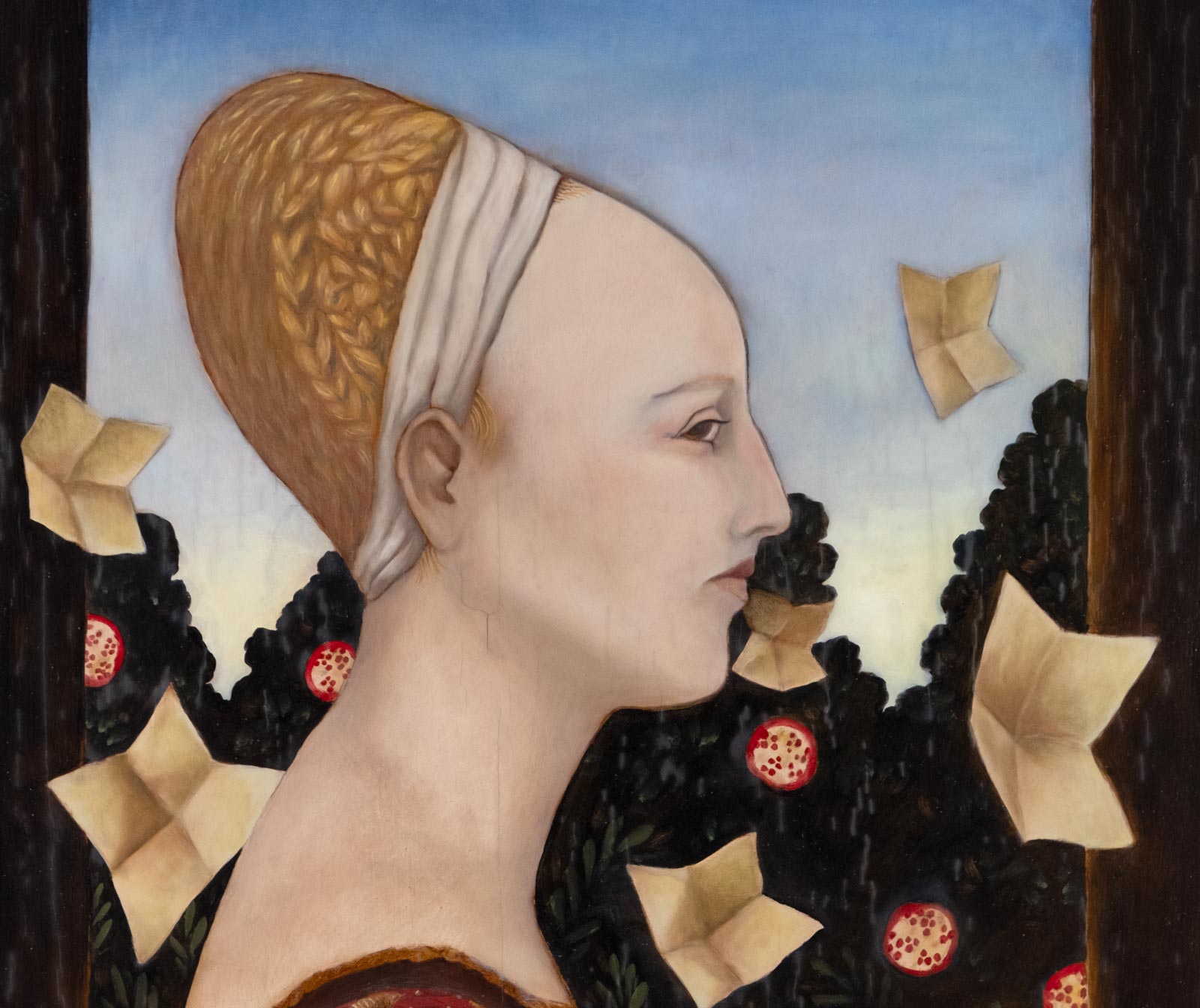
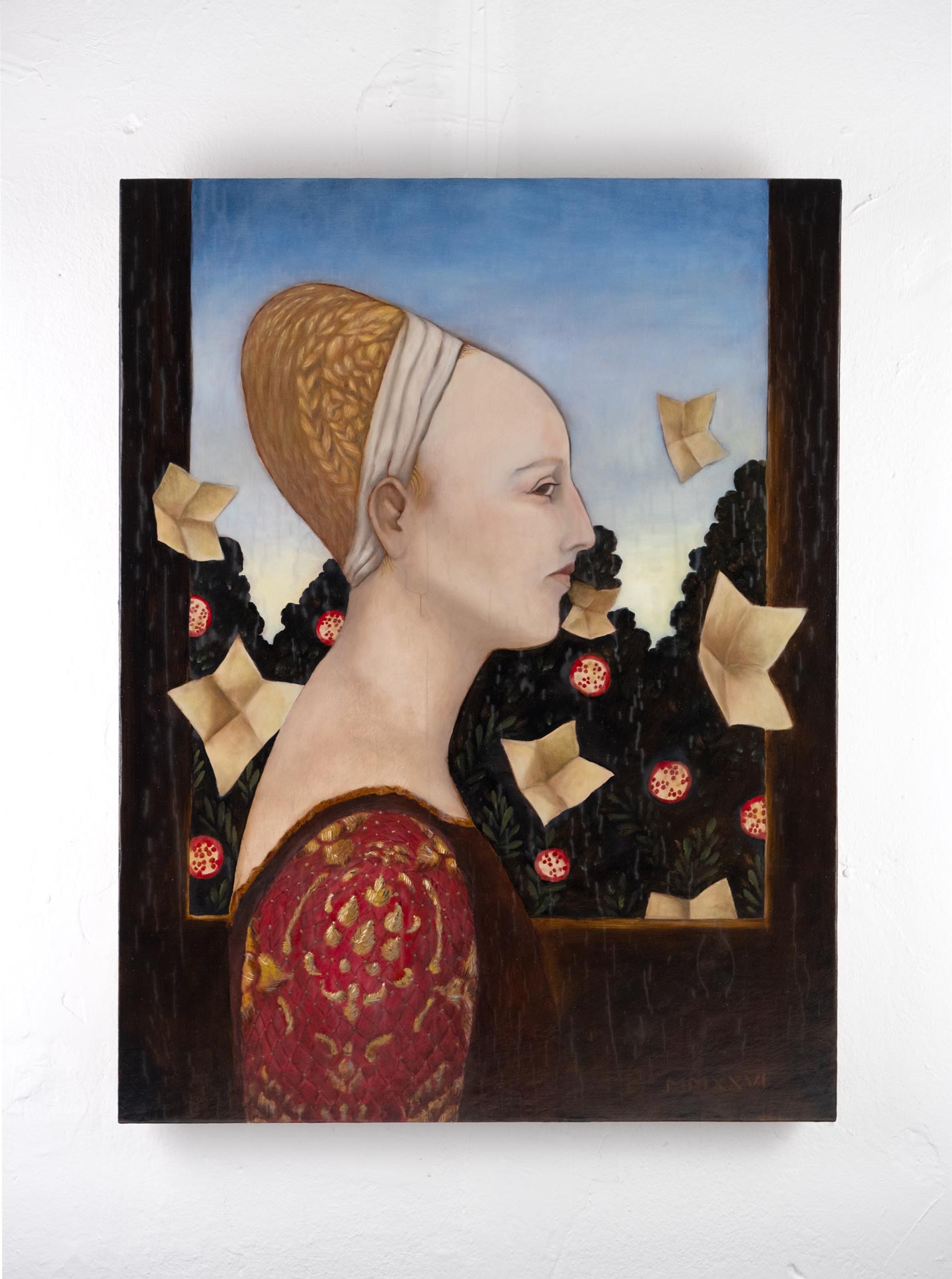
The portrait shows her in the classic Renaissance profile. Through the window, folded papers fly – symbols of her intellectual freedom, which knows no walls.
"Isotta Nogarola had to give up her womanhood in order to be accepted as a scholar in the circle of men. In my portrait of her I show her as a potential bride who can only be free in the seclusion of a cell." –Roxana Panetta
About the Portrait
Isotta does not look to the right, as is customary in Renaissance wedding portraits. For no husband awaits her opposite. She finds herself in an enclosed room. Only a window allows her thoughts – in letter form – to fly freely.
The portrait combines the typical Renaissance wedding portrait of a noble woman with Isotta Nogarola's decision: better free in a cell than unfree in a marriage.
To belong amongst the scholars, she must shed her womanhood – say the men
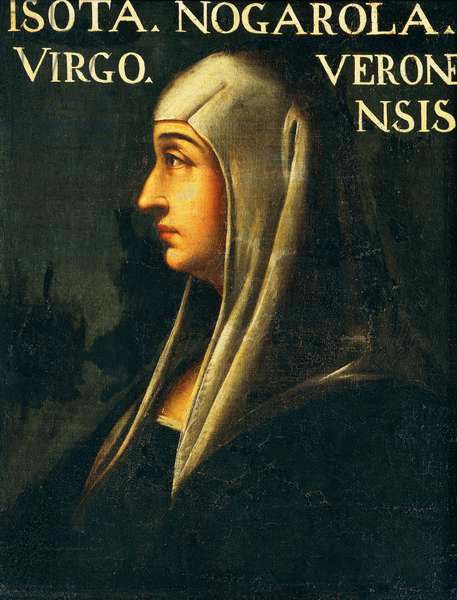
There are several posthumous portraits of Isotta Nogarola that invariably show her dressed like a nun. In one illuminated manuscript she is surrounded by books: it shows her in the "book-lined cell" into which she had voluntarily withdrawn (in her mother's house, mind you, not in a convent). Other depictions show her simply in profile, with a headscarf, without further attributes – like a nun.
These representations conceal the fact that Isotta Nogarola did not consider herself a nun at all, but rather wanted to lead a life of study and philosophy – just like the learned men. In my interpretation I therefore explicitly show her as a young, beautiful woman who poses in profile, as was customary for a wedding portrait at the time.
In my portrait she is entitled to both: to be woman and scholar
She wears an ornate gamurra, the garment of the period, and her hair is pinned up – she is not a nun, she is a woman from a noble family. In my portrait she need not look like a nun in order to be taken seriously as a scholar. Ordinarily her gaze would turn to the right – towards the pendant portrait of her husband. Instead she looks to the side, towards us as there is no husband. An examining gaze.
Free... in seclusion
Through the open window, folded letters fly freely about. It is the freedom of her thoughts, which she may only live out in this enclosed room. She may think freely, so long as she does not move freely – the bitterness of her lived reality resonates here.
Historical images and other original sources
(click on the image for enlargement and details in the caption)
-
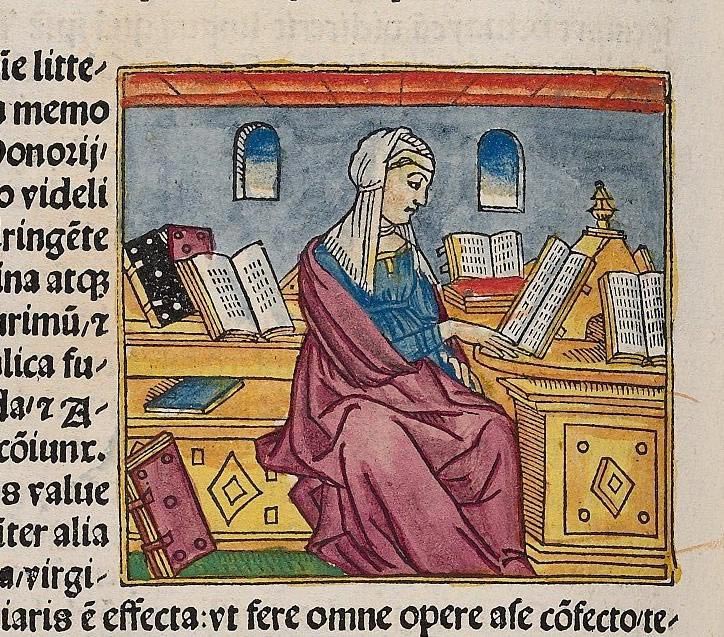 Colored wood print from "De Claris Mulieribus" by Foresti and Augustin (Ferrara, Italy, 1497)
Colored wood print from "De Claris Mulieribus" by Foresti and Augustin (Ferrara, Italy, 1497) -
-
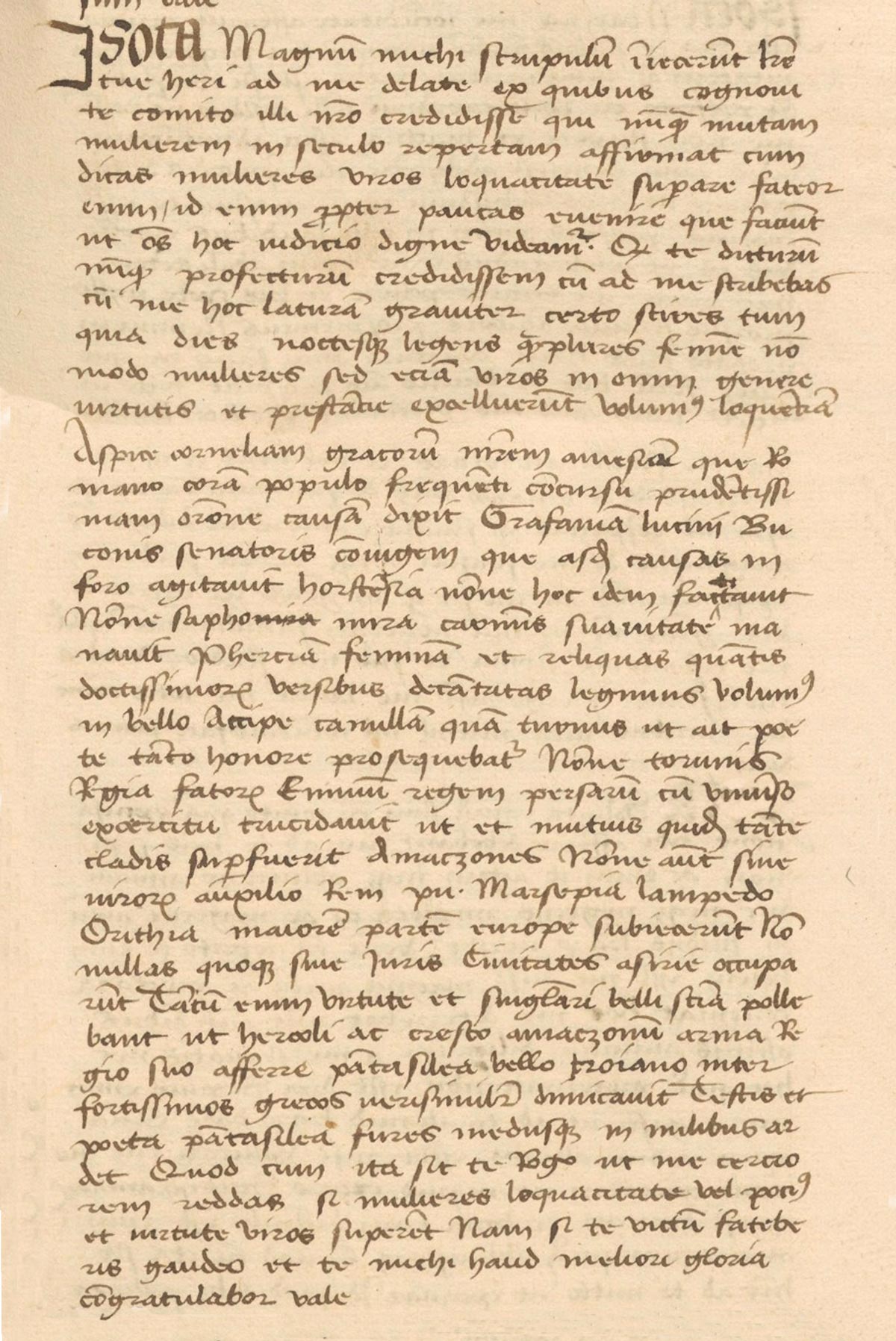 A contemporary copy of a letter written by Isotta Nogarola in April 1439 to Damiano del Borgo
A contemporary copy of a letter written by Isotta Nogarola in April 1439 to Damiano del Borgo -
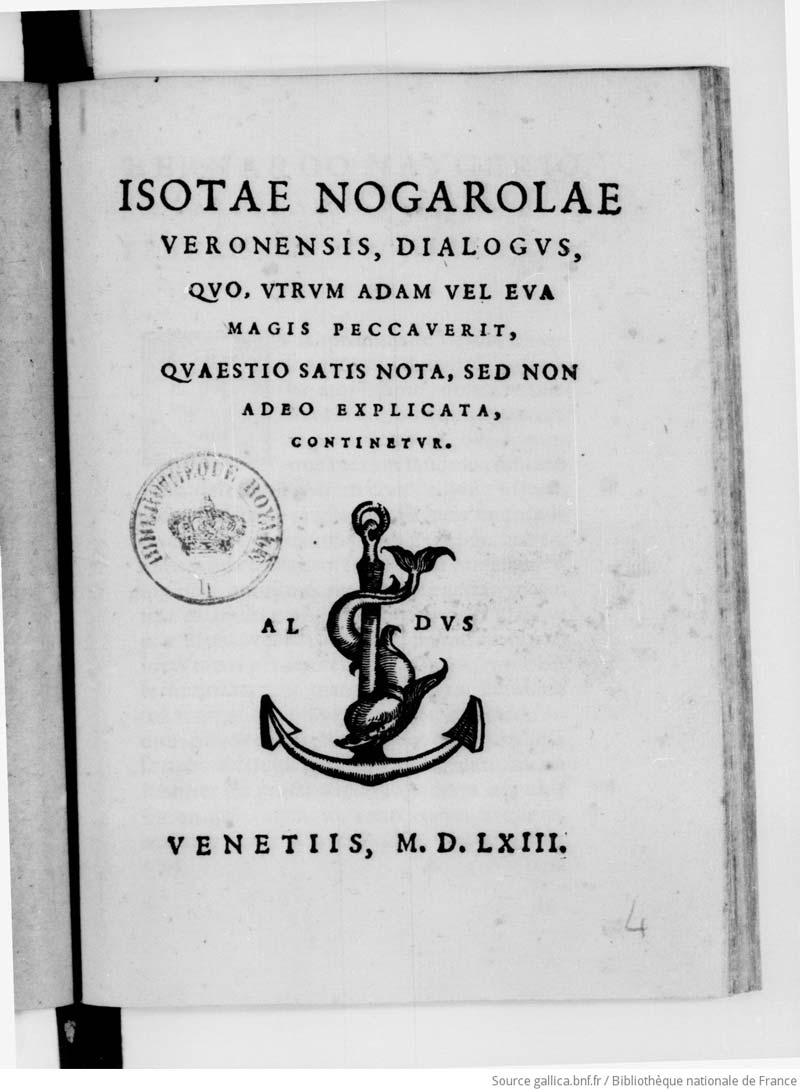 Front page of a 1563 publication of Isotta Nogarola’s text on the question of original sin (source: Gallica, National Library of France)
Front page of a 1563 publication of Isotta Nogarola’s text on the question of original sin (source: Gallica, National Library of France) -
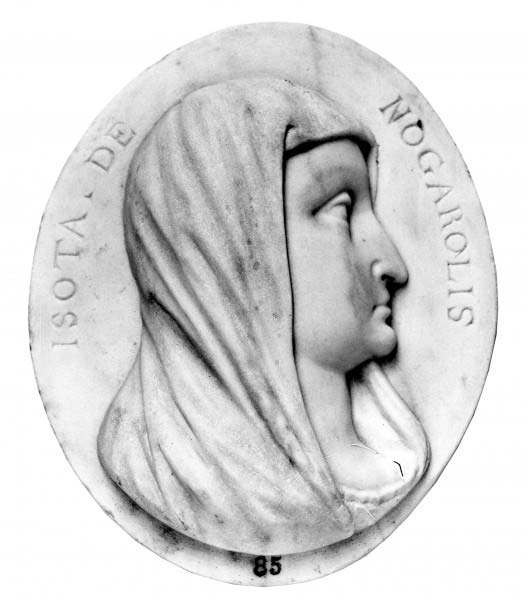 A marble relief which, along with 75 other such reliefs, adorned the Church of San Giovanni di Verdara in the 18th century (image and information: Museo Civico di Padova)
A marble relief which, along with 75 other such reliefs, adorned the Church of San Giovanni di Verdara in the 18th century (image and information: Museo Civico di Padova)