

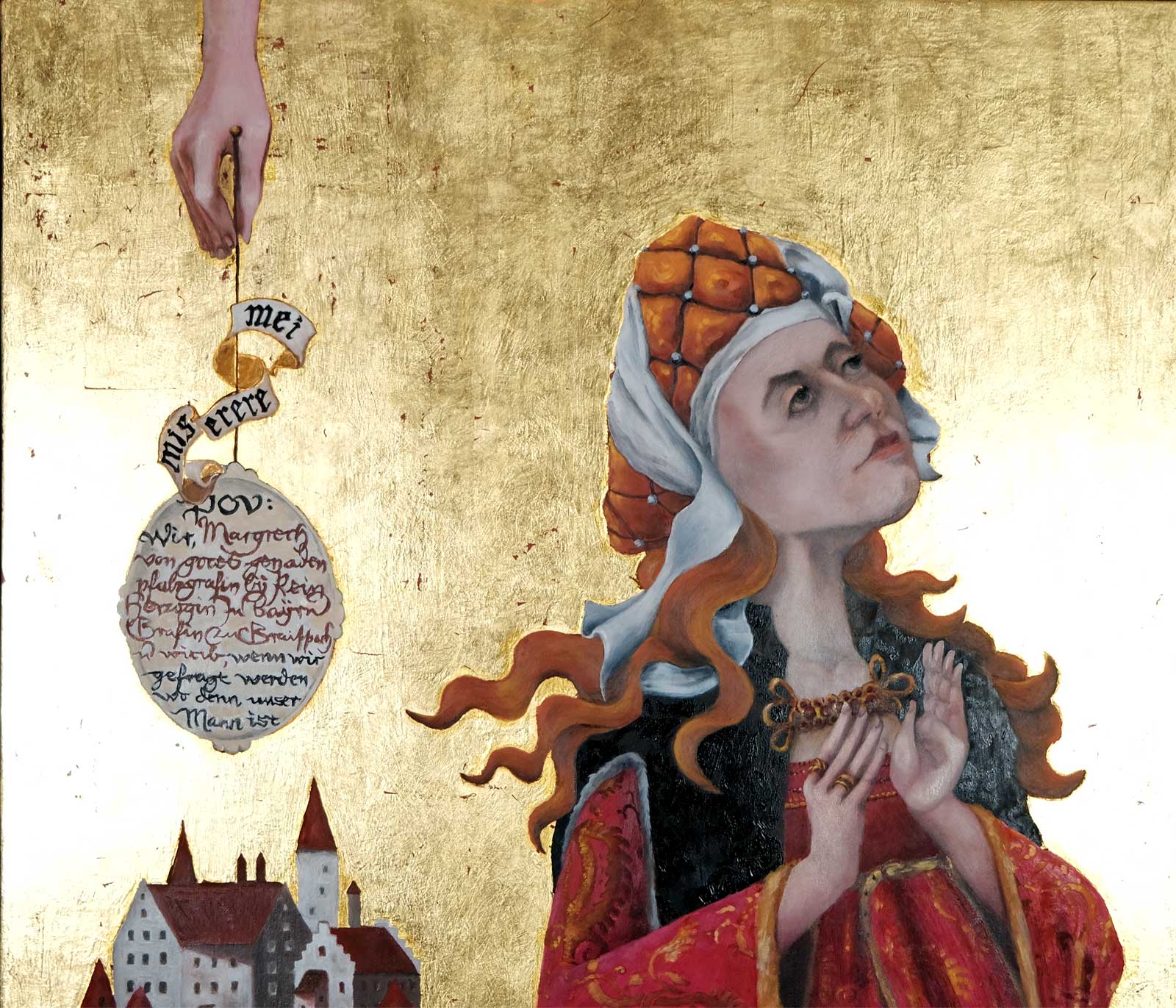
Margarethe of Brandenburg
Duchess of Bavaria, Princess of the Hohenzollern, Mother, Strategist
Margaret of Brandenburg, Duchess of Bavaria
* c.1413 (Cadolzburg nearby Nürnberg), † 1465 (Landshut)
Margaret of Brandenburg was born as the daughter of the Burgrave of Nuremberg, who soon thereafter received the Electoral dignity. Her parental house thus rose to the high nobility when Margaret was just two (or five) years old. Her father was now Frederick I, Elector of Brandenburg. As was customary in Margaret's time, she was betrothed and married to form strategic alliances. It was a crucial phase for her family!
In Margaret's case, she was once betrothed (without marriage, as her betrothed died), once married (without consummation of the marriage, as her husband died), then married again... and after four years, widowed once more. What Margaret said about all this, we unfortunately do not know. For us, this impression remains: the woman as a strategic playing piece, not as a person. Margaret, however, took her fate into her own hands and ultimately decided to marry for herself – this time for love – and secured all the financial means to live with dignity and independence.
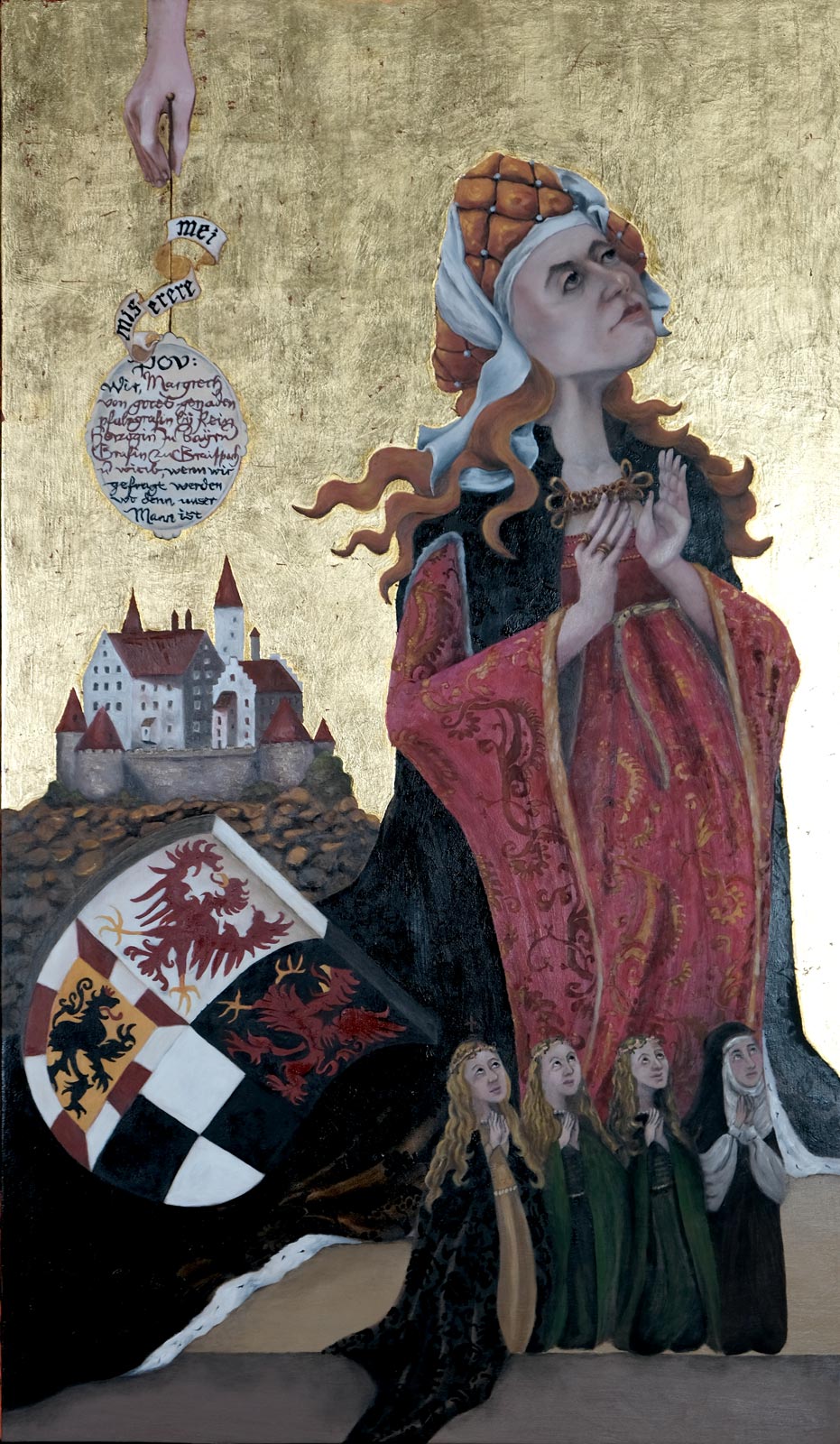 Margaret and her three husbands
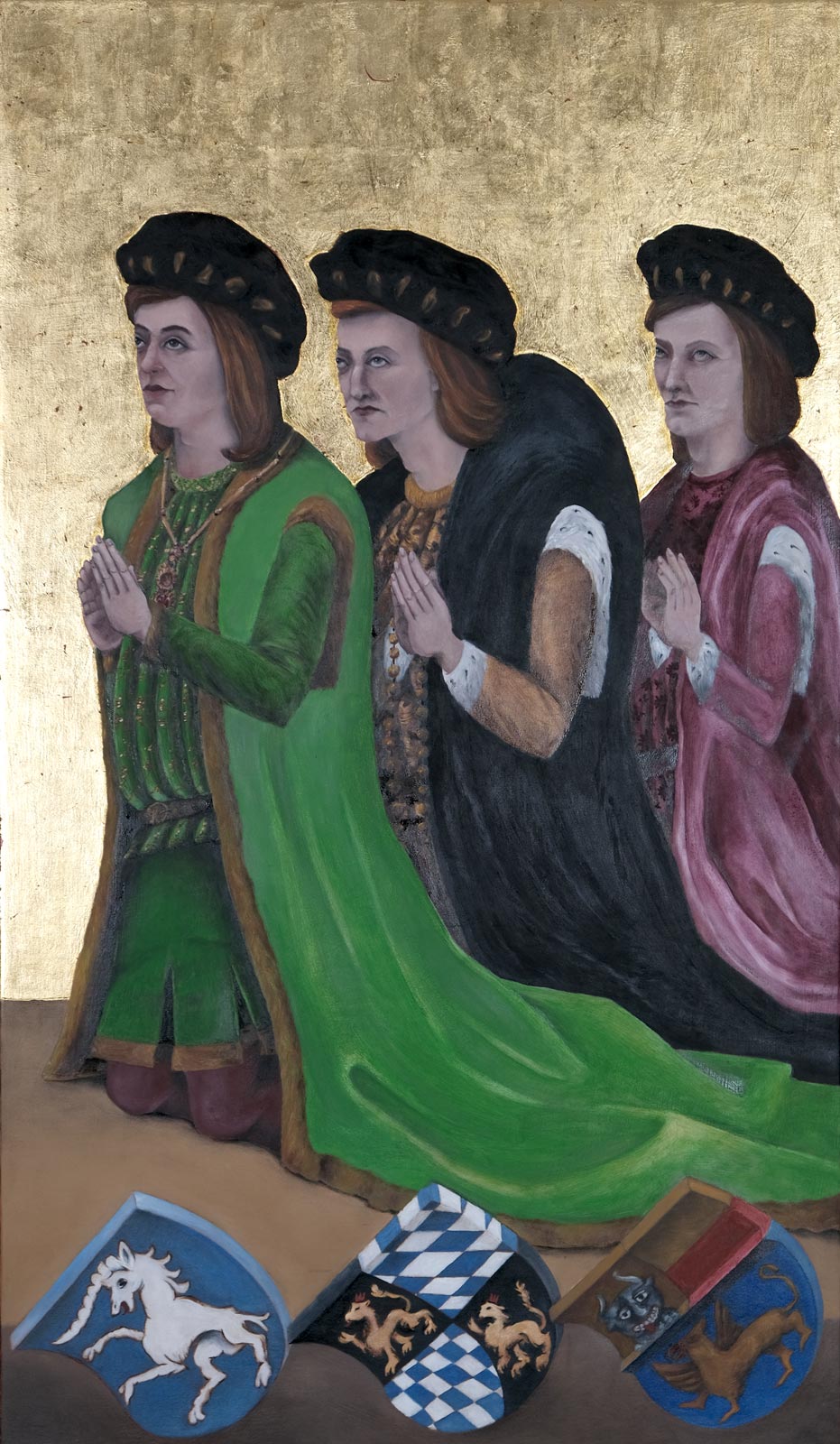 Margaret and her three husbands
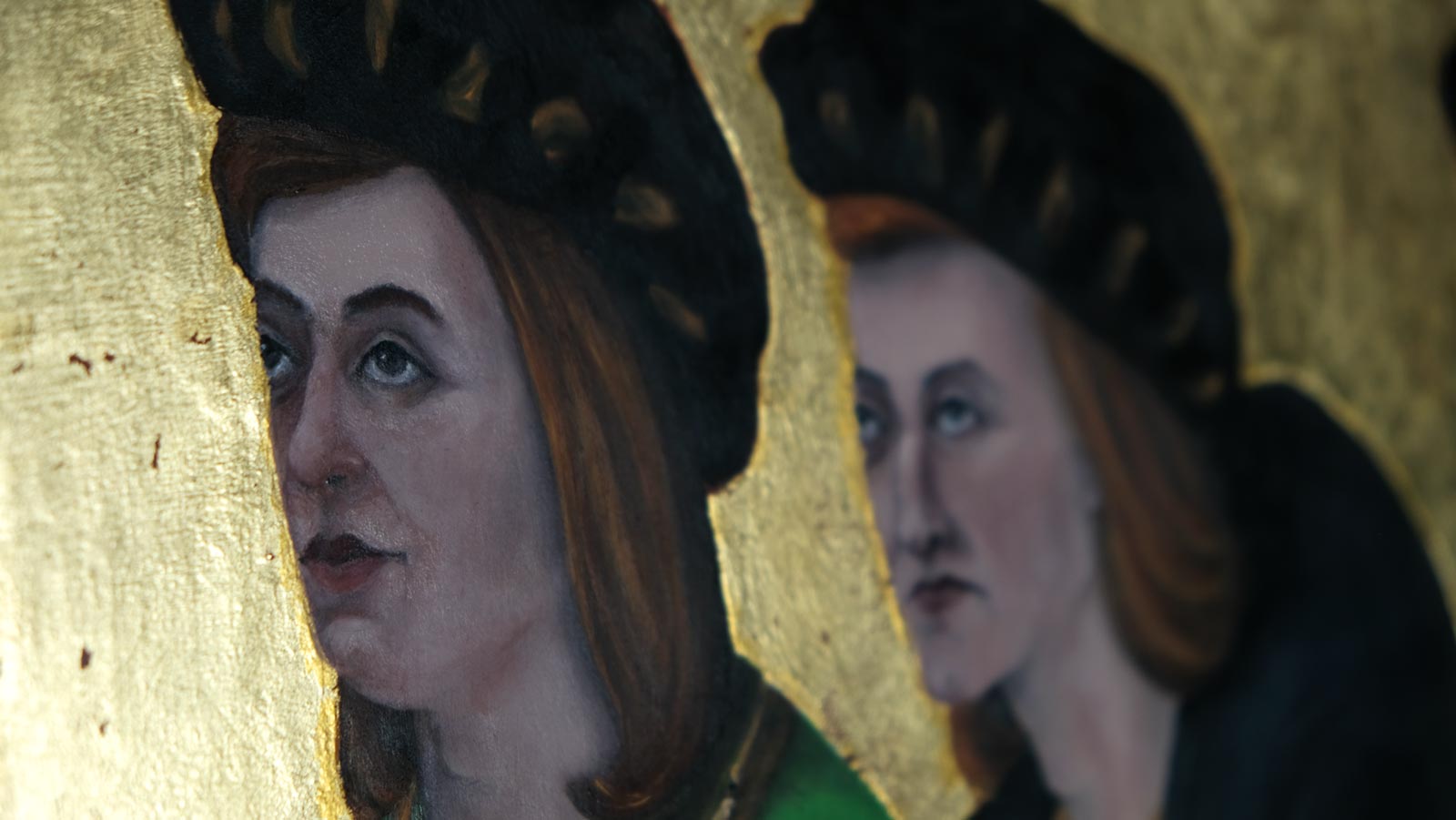 Detail: Portrait of Margaret of Brandenburg (c.1413-1465)
In this portrait, I show a strong woman who holds her head high and assumes a role. Behind her stands a mountain of gold coins (the treasure she received from selling her father-in-law), upon which an idealized castle complex represents all the estates she additionally secured from delivering her father-in-law: Rain, Schrobenhausen, Neuburg (on the Danube), Isareck, and Aichach. At her feet are her four daughters: the first daughter Katharina from her second marriage to Louis, the second and third daughters (in green garments) from her third marriage to Martin, and the fourth daughter, also from the third marriage to Martin, as a nun. Offspring was a sign of efficacy and achievement. Margaret provided for her daughters – securing husbands for Katharina and Dorothea and, in Affra's case, a safe place in the convent.
Hidden Messages
The banderole to her left imitates the handwriting from her letters (which were very likely written by secretaries) and contains a text that reveals this portrait is not historical: "POV: We, Margreth by the grace of God Countess Palatine of the Rhine, Duchess of Bavaria, and Countess of Graispach and widow, when asked where our husband is." This ironic allusion to a phrase women in leadership roles still often encounter today – also in the variant: "Where is your boss?" – captures how Margaret must have often been confronted: Not her will, but that of her husband counted – yet she evidently did not want to be reduced to the role of an "obedient" wife. Her biography suggests this.
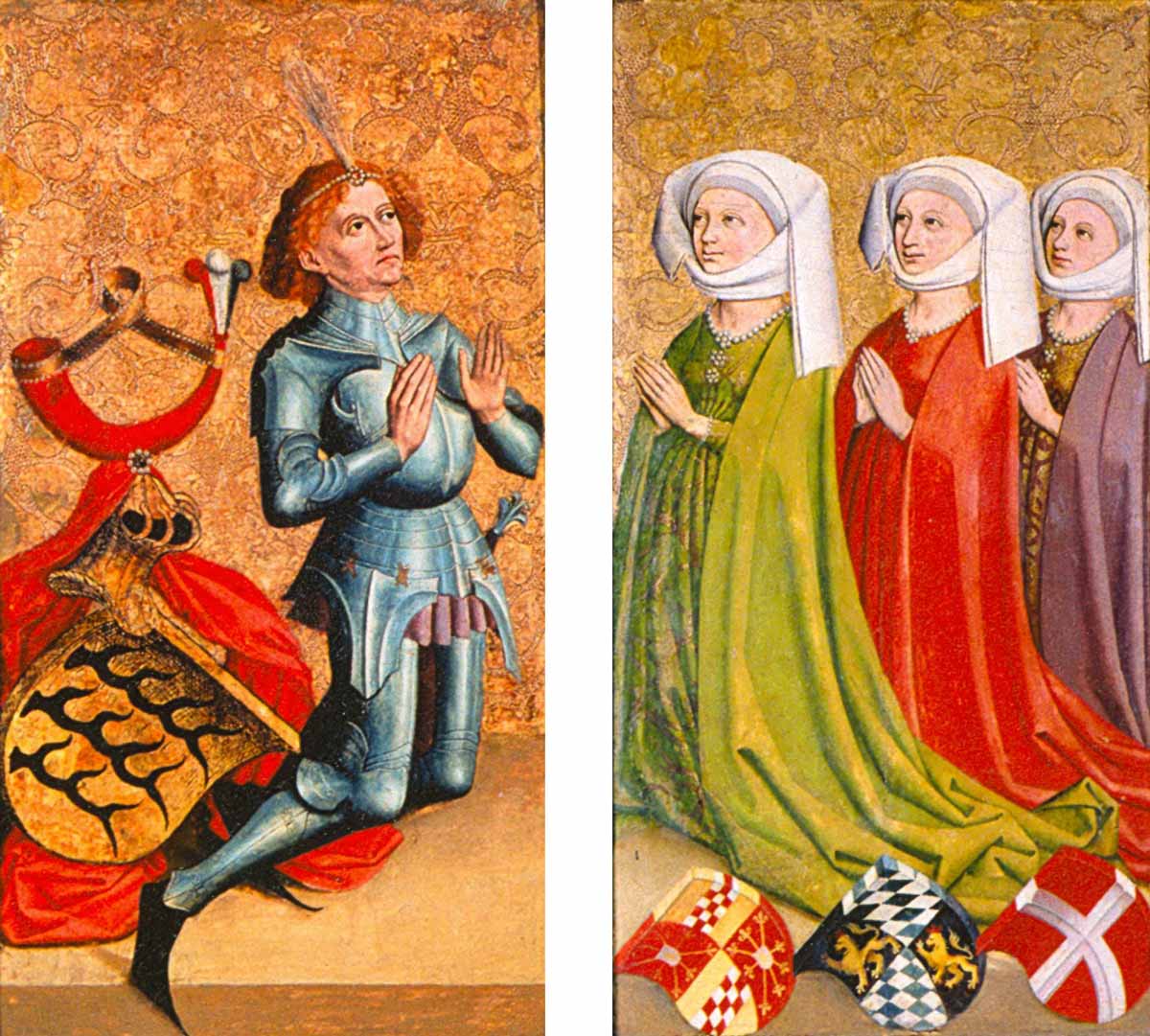 Count Ulrich V. "the Beloved" of Württemberg
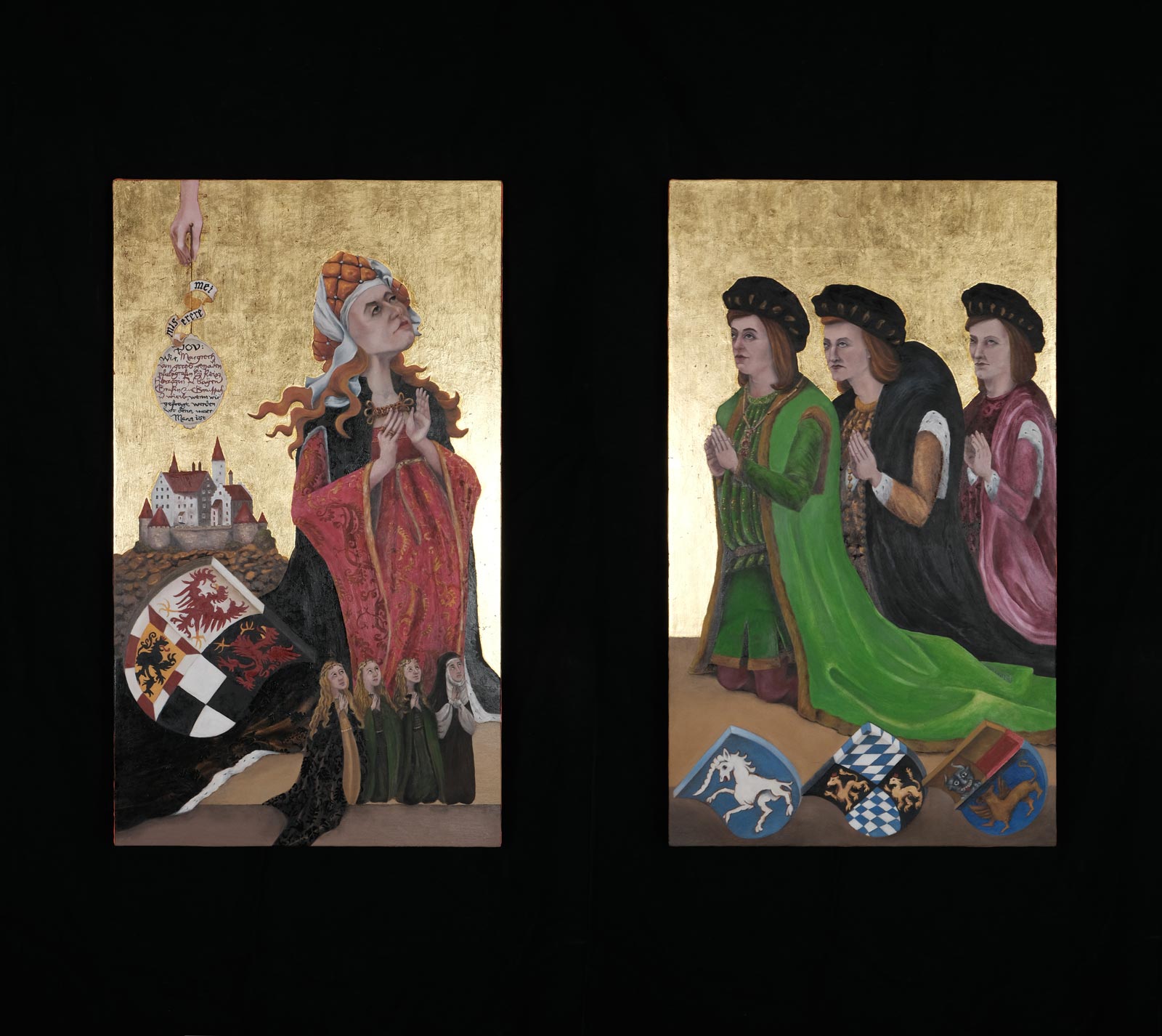 Margaret and her three husbands
With her behavior, Margaret reversed many notions of a female role at court. She decided on a marriage (to a man of lower rank). She provided for this man and the daughters born from the marriage. After her death, her husband had a home, a "widower's seat," completely unusual for the circumstances of that time.
I show this reversal with a certain irony by taking up a historical donor image from around 1470/80 and reversing the roles: on the left, Margaret assumes the decisive, central role in a gold-embroidered gown with a dark fur cape with ermine trim. Her possessions are clearly visible. On the right panel, her three husbands line up, with individual facial features but without indications of power and function. The two dukes (in the middle and right) wear neither ducal caps nor weapons. They are beardless, like youths, delicate and devoted. Martin (left) wears the Order of the Swan, which he actually wore, as a sign of deep connection to Margaret's family. Louis holds a rosary as a sign of his piety. The coats of arms at their feet are the respective family crests.
Biography
Betrothed, married, widowed, married, widowed, married
At the time of her birth, Margaret was not yet a princess, as the Electoral dignity was only granted to her father, the Burgrave of Nuremberg, in 1415. Her father had aspirations to elevate the family into the high nobility, and strategically chosen marriage partners played a major role. In the year of her birth, she was betrothed to the promising Pomeranian prince Wartislaw, who, however, died soon thereafter (around 1414/1415). In 1423, she was married to Duke Albert V of Mecklenburg-Schwerin. Her parents, Frederick I of Brandenburg and Elisabeth of Bavaria, were ruling in Brandenburg at this time. Unfortunately, Margaret's husband died before the couple could live together. The marriage was thus not consummated, and a dispute arose over what widow's pension she was entitled to. Consider: Margaret was around 10 years old at this time.
Nearly 20 years in uncertainty
Many years passed during which Margaret's fate was unclear. In 1431, a certain Duke Louis VIII of Bavaria-Ingolstadt expressed interest in her. He had lost territories to her father in the Bavarian War of 1420-1422 and hoped to regain these territories through a marriage to Margaret. But it took years before the two were betrothed (1438), and then another year passed before Margaret and Louis, called "the Hunchback" or "the Humpbacked," married: 1439. Margaret was already around 28 years old. So many years of waiting and uncertainty! What Margaret received with this marriage: internal family strife. Her father-in-law did not want to make his son – her husband – his heir, but rather the child from another relationship. Margaret stood by her husband, and together they ensured that the father-in-law could finally be captured. Together they built a regency; Margaret proved herself to be a truly worthy regent.
Selling the father-in-law, following the heart
Then Louis died after only few years of marriage (1445) – leaving behind a Margaret who had a factually "valuable" father-in-law in the dungeon and apparently no longer wanted to endure any further arrangements by her family. And evidently was also not prepared to live the life of a widow from now on – provided for but socially invisible. She "sold" her father-in-law – delivered him to the Duke of Landshut in exchange for a significant sum of money and various estates – and then secretly and completely independently married her steward, with whom she would have three daughters. She provided for everyone: her husband would be able to spend his twilight years on his own "widower's seat," and she secured her daughters with money, husbands, and in the case of the youngest daughter, a place in the convent. So that her daughters could not be cheated out of their sums of money, she deposited the money in the free city of Augsburg. Such a thing was already possible in the 15th century!
A woman who defied expectations
Viewed this way, Margaret appears to us as a woman who on the one hand accepted family conditions and on the other hand showed that patience is finite. She too wanted to shape her destiny. She decided, took responsibility, acted with foresight. Not everyone liked that during her lifetime. She is described as ugly and massive. How much of this is objectively true, and how much is slander because her behavior did not conform to expectations? Her third marriage to a man of lower rank led to a break with her parents. She no longer appears in any correspondence – excluded by her own family of origin. Her husband, after she died in 1465, was reconciled with her brother Albrecht Achilles, who had meanwhile become Elector of Brandenburg. His name can be found again in the records after 1465.
Historical Images and Textual Material
Very little surviving material from Margaret exists (so far)
(Click on the image for enlargement and caption)
-
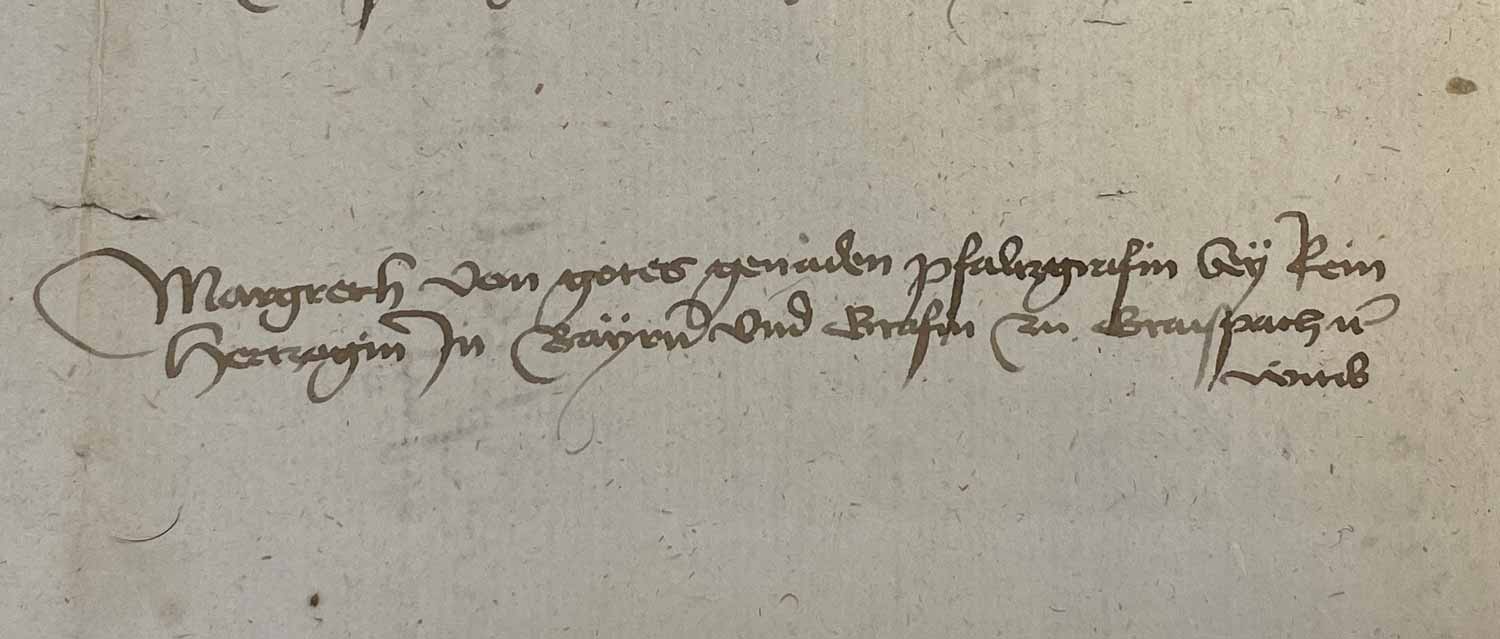 Original letter: Margarethe described herself as follows: Margreth, by the grace of God, Countess Palatine of Rein, Duchess of Bavaria and Countess of Graispach a(nd) witib (widow)
-
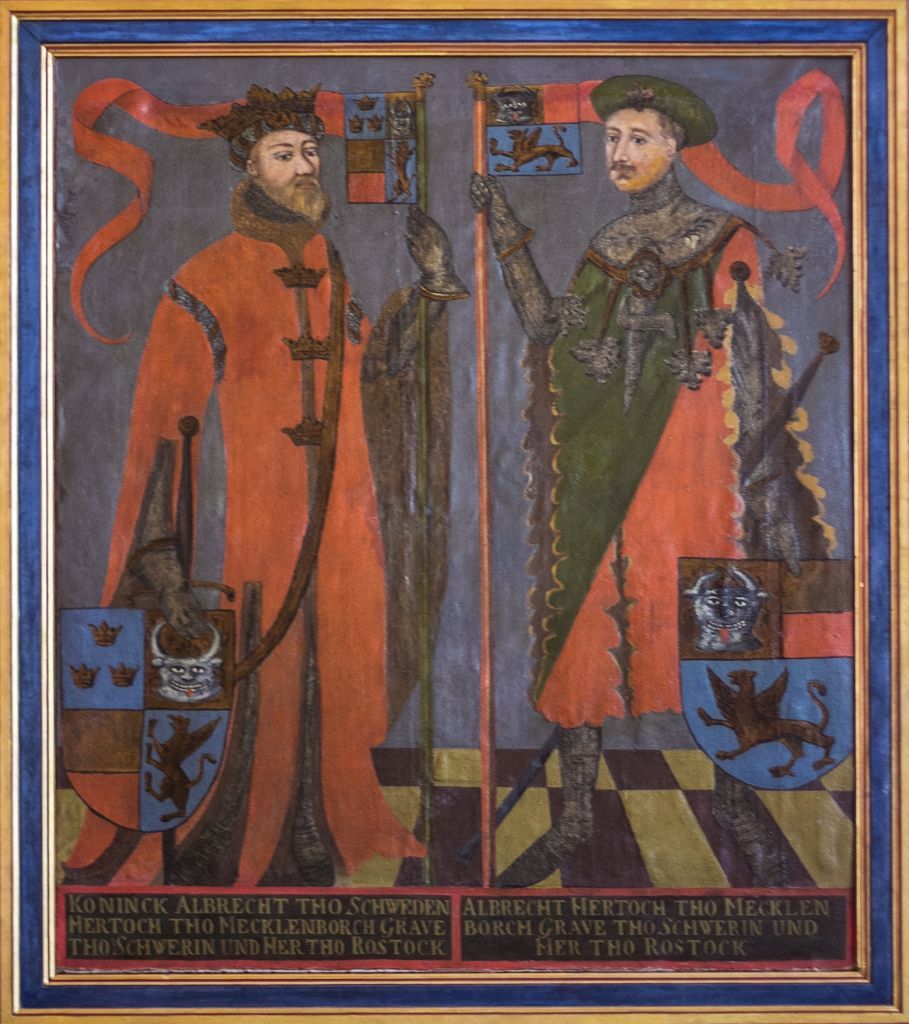 Right: Duke Albrecht V of Mecklenburg-Schwerin (born 1398/99–1423), whom Margarethe married in 1423. However, Albrecht died before the couple could "move in together", and therefore her widow's inheritance was disputed for years.
-
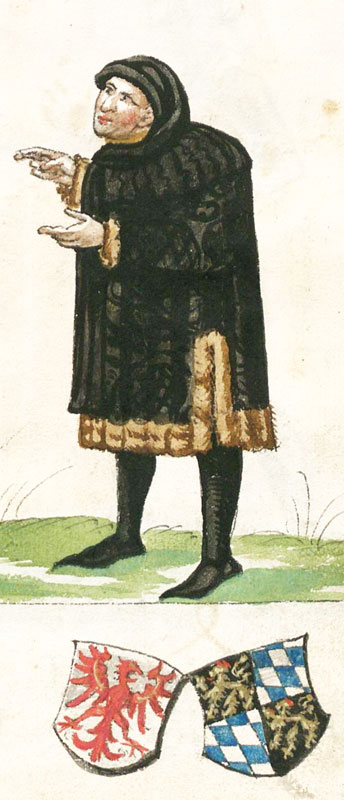 Duke Louis VIII of Bavaria, known as ‘the Hunchbacked’, first waged war against Margaret's father, but later married her in 1439 after years of negotiations. Margaret thus waited 16 years for her destiny. However, Louis died in 1445.
-
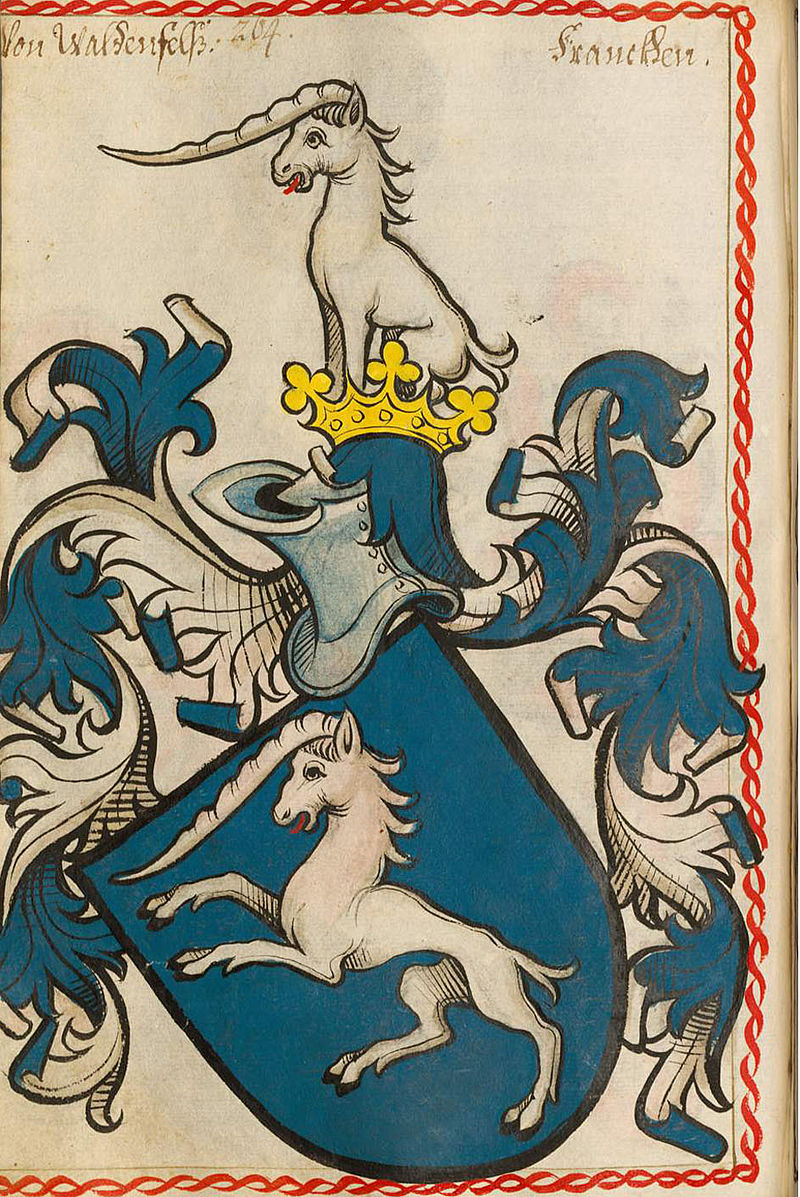 The coat of arms of the Waldenfels family. Margarethe's husband also wore the Order of the Swan and was loyal to the Elector of Brandenburg and Margarethe's steward until they married in 1447 and had three daughters.
-
Altarpiece (c. 1470–80) depicting Count Ulrich V of Württemberg, known as ‘the Beloved,’ showing him on the left in imposing armour as an individual, but his three noble wives all look identical, as if they were decals.
-
 Typical clothing worn by noblemen during Margaret's era