

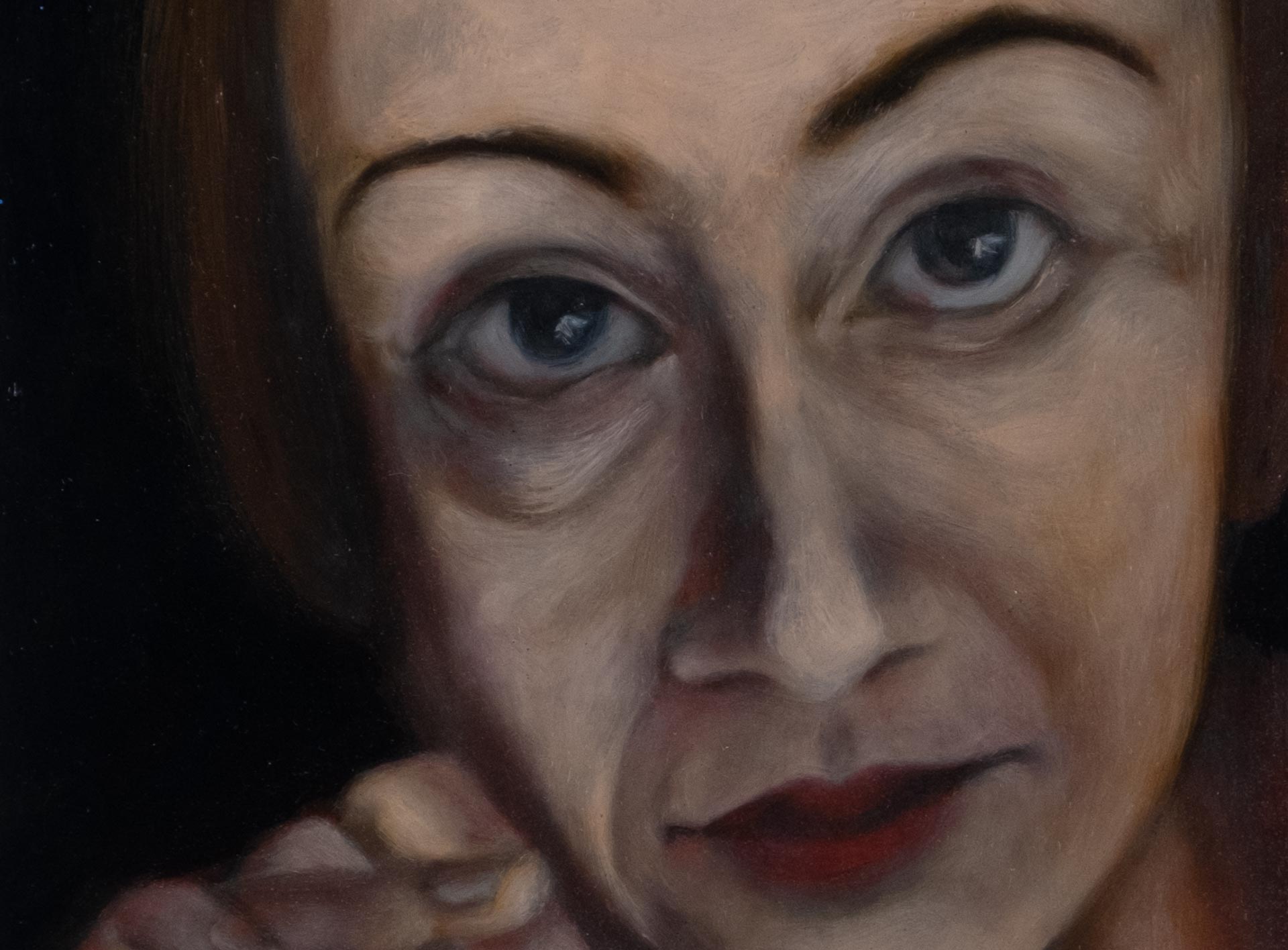
Barbara von Brandenburg
Queen of Bohemia. Not.
Barbara von Brandenburg
* 1464 (Ansbach), † 1515 (Ansbach)
The daughter of the influential Elector of Brandenburg, Albrecht Achilles, was married and raped at the age of 10. By 12 she was already a widow and heiress to important territories, and in the same year, 1476, she was married to the King of Bohemia. But the king lost interest in the dwindling territories and left Barbara with her family. She lived poorly provided for, far below the station of a queen, with her brothers.
Barbara fought back: in 1492, after 16 years of waiting, she wrote to the Pope herself requesting an annulment of the marriage, and secretly became engaged to a knight. Her brothers then imprisoned her – for years. The marriage was not dissolved until 1500. Barbara died in 1515, unmarried and impoverished.
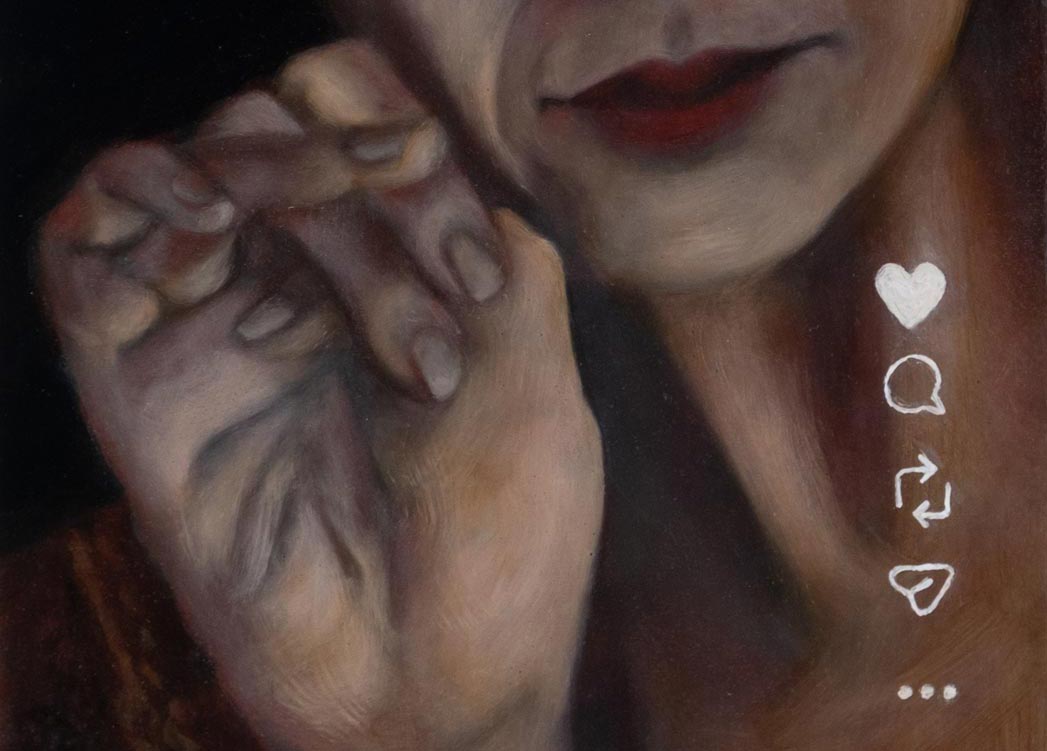
In the portrait she makes a hand gesture that victims of violence use when they can be seen but not heard – a signal that emerged 500 years later.
"Barbara's fate as a sold bride is still reality in parts of the world today. With this rather contemporarily emphasised portrait, I build a bridge from the 15th to the 21st century."
–Roxana Panetta
About the Portrait
The small, narrow portrait in upright format shows us a desperate, weakened young woman who gazes at us with wide eyes from the darkness whilst making a hand gesture. It is a gesture from the 21st century: one shows the open palm, folds the thumb inward, and the fingers successively enclose the thumb until the fist is closed. This gesture can be shown silently in passing and means: "I am in danger and the person accompanying me is holding me against my will."
In the bottom right of the image are the symbols "heart" (like), "speech bubble" (comment), "paper aeroplane" (share), and three dots (more options), as known from TikTok and Instagram.
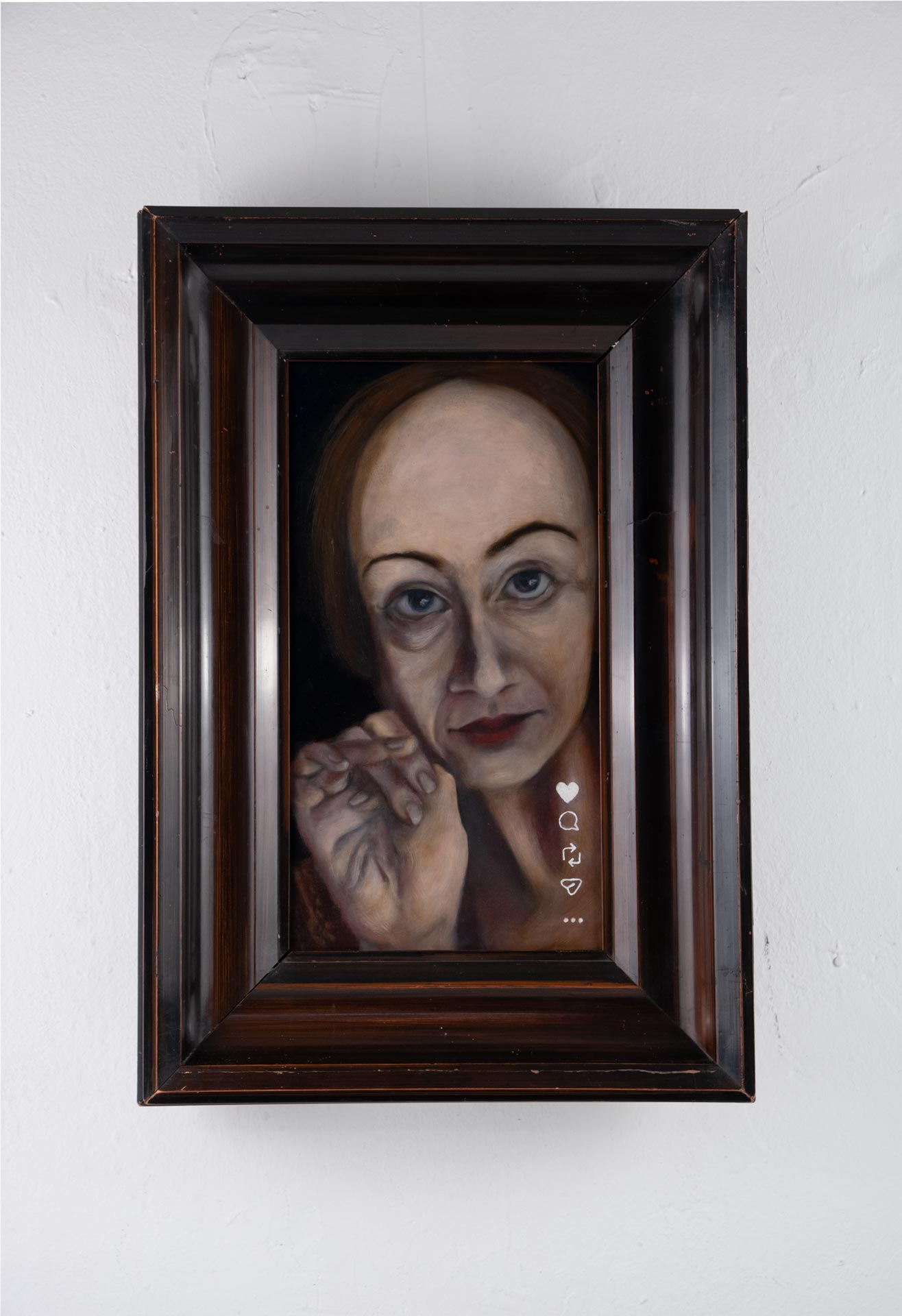
For the portrait of Barbara von Brandenburg I have chosen an entirely different form of representation: I show her not as a queen, but as a victim of violence and dehumanisation. She is imprisoned; the dark, deep wooden frame emphasises her prison cell. Her hand gesture calls out to us: "I am imprisoned!" We read her pain in the shadows beneath her eyes. But her gaze also says: "I am here. You must see me!"
Barbara insisted on her right to be treated as a human being – and was punished for it. For her family she was an object of negotiation, not a person. What she wanted was of no significance whatsoever. She fought desperately against this.
Letters to her father survive in which one can read her despair: "nymants über mich erbarmen will" (no one will have mercy on me), "ellendiglich versetzt" (miserably abandoned), "bin sunst ganz verlassen dann ich sunst nymants han dann got und euch" (am utterly forsaken for I have no one but God and you). Even an archival note records: "ein sehr klegliches Schreiben" (a very pitiful letter). All this lamenting was to no avail. She threatened to present her situation to the Emperor or elsewhere – and then did so in 1492: she wrote to the Pope. The result: her brothers treated her like a criminal and locked her up.
Biography
A woman treated as an object resists – and pays for it with her freedom
In 1474, aged ten, Barbara was married to Henry of Glogau. Her father saw this as a good match, as the considerably older (and ill) Henry possessed important and extensive territories. The Duke brought the child bride to his court, where she was to learn courtly ways. But he also "consummated the marriage" immediately with the bride, who was still a child (today we would speak of rape). Glogau died in 1476 and Barbara became heiress to important territories. Her father and brothers sensed an opportunity to marry the young widow off even better: to the King of Bohemia, who had set his sights on precisely those territories. A proxy wedding was arranged, which at the time was customary and legally constituted a marriage. A win-win for everyone, it seemed. For Barbara: tragic.
A succession dispute followed with the brother of the deceased Duke of Glogau, and soon the territories "belonging" to Barbara and her family dwindled. The King of Bohemia showed no interest in bringing his queen, Barbara, to him. Barbara lived with her brothers, needed expensive clothing (because she was still growing), and was otherwise very costly to maintain, as she was entitled to provisions befitting a queen. None of this was granted to her. And years passed.
When her situation became unbearable, Barbara wrote to the Pope herself requesting an annulment of the marriage. She secretly became engaged to Conrad von Haydeck, a knight beneath her station. She knew exactly what she was doing – and did it anyway. All behind her family's back.
Her brothers discovered Barbara's attempts to free herself from the de facto non-existent marriage and subsequently imprisoned her at Plassenburg Castle. For years. The conditions of detention were brutal: an iron door, two guards keeping watch day and night, a small hatch through which "jre notturfft aus und eingegeben werdenn soll" (her necessities were to be passed in and out) – as the records describe it. She lived there with two maidservants, isolated, imprisoned.
Barbara implored her brothers in letters: "walt ir mich mein lebtag yn der gefencknus lassen" (will you leave me in prison for the rest of my life). She reminded them of their own salvation: "das irs an eur aigen swester ein solch ubel tut" (that you inflict such evil upon your own sister). The brothers wanted to arrange another marriage, but Barbara requested "man soll ir doch keinen gebn der ir nicht gefall" (they should not give her a man who does not please her). The response was ice-cold: "warumb man das thon solt" – why should we do that? Barbara's wishes were of no significance whatsoever. The brothers even threatened to make her imprisonment more severe: "in enger versliessung dann ir yezund seyt" – even tighter than now. Barbara did not give up her resistance.
It was not until 1500 – eight years after her first cry for help – that the marriage was dissolved. In 1507 she moved to live with her mother (Anna of Saxony); from 1508 she received an annuity of 150 guilders – "a very small sum for a woman of her station", as research notes. She died in 1515, unmarried and impoverished.